
Introduction
The FIFA World Cup 2026 is not just the biggest football tournament in the world—it is also one of the most profitable sporting events ever created.
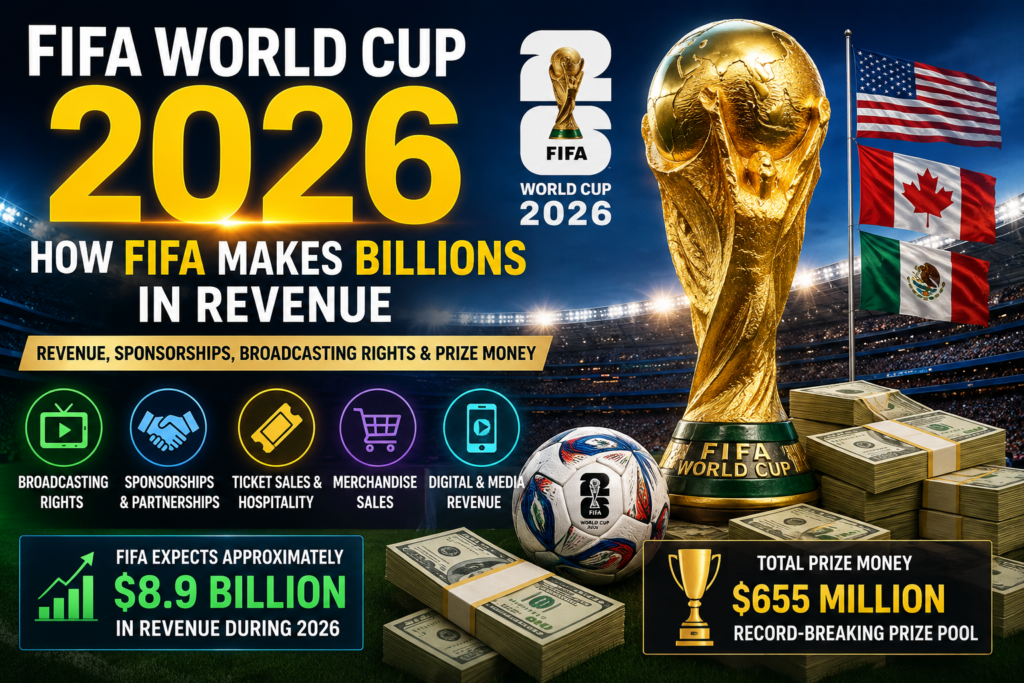
Hosted by the United States, Canada, and Mexico, the 2026 FIFA World Cup features 48 teams and 104 matches, making it the largest World Cup in history. With billions of viewers expected to watch the tournament worldwide, FIFA is projected to generate record-breaking revenue. According to FIFA’s official financial projections, the organization expects approximately $8.9 billion in revenue during 2026 alone, largely driven by the World Cup.
But where does all this money come from?
Let’s break down FIFA’s business model and explore how the organization turns football into a multi-billion-dollar global industry.
Why Is the FIFA World Cup So Valuable?
Very few events can attract the attention of billions of people simultaneously.
The FIFA World Cup combines:
- Global television audiences
- Massive sponsorship deals
- Premium ticket sales
- International tourism
- Digital media partnerships
- Merchandise sales
Because of this unique combination, the World Cup has become one of the most valuable sports properties on Earth.
1. Broadcasting Rights: FIFA’s Biggest Source of Revenue
If there is one reason FIFA earns billions, it is broadcasting rights.
Television networks and streaming platforms pay enormous amounts of money to obtain permission to show World Cup matches.
FIFA’s official budget shows that broadcasting rights are expected to contribute roughly $3.9 billion, making them the largest single revenue source for the 2026 World Cup cycle.
Why are broadcasters willing to pay so much?
The answer is simple: viewers.
Billions of football fans watch the World Cup, giving broadcasters the opportunity to sell advertising at premium prices. In fact, analysts have noted that some World Cup advertising opportunities can approach Super Bowl-level values because of the tournament’s enormous audience.
2. Sponsorship Revenue
Another major source of income is sponsorship.
Large multinational companies want their brands associated with the world’s most popular sporting event.
Companies invest hundreds of millions of dollars to become official FIFA partners and sponsors because the tournament provides unmatched global visibility.
Sponsors benefit from:
- Stadium branding
- Television exposure
- Social media campaigns
- Digital advertising
- Promotional partnerships
Recent FIFA commercial partnerships include major global brands across technology, travel, beverages, payment services, and consumer electronics. Sponsorship revenue remains one of FIFA’s strongest revenue streams.
3. Ticket Sales and Hospitality Packages
Ticket sales are another important revenue source.
Millions of football fans travel from around the world to attend matches in person.
For FIFA World Cup 2026, ticket demand is expected to reach record levels because:
- The tournament has expanded to 48 teams.
- There are more matches than ever before.
- Three countries are hosting the event.
According to FIFA’s revenue plans, hospitality rights and ticket sales account for roughly one-third of projected 2026 revenue.
Premium hospitality packages can cost thousands of dollars and include luxury seating, exclusive lounges, and VIP experiences.
The World Cup Final is particularly valuable, with premium tickets reaching extremely high prices due to global demand.
4. Merchandise Sales
The World Cup creates enormous demand for football merchandise.
Fans purchase:
- National team jerseys
- Footballs
- Scarves
- Caps
- Collectibles
- Souvenirs
Merchandise sales generate additional revenue for FIFA and its licensing partners.
Every World Cup creates a surge in football-related consumer spending, especially among supporters of popular national teams.
5. Digital Media and Online Revenue
Football fans no longer consume content only through television.
Today, FIFA earns revenue through:
- Digital advertising
- Online video content
- Streaming partnerships
- Social media campaigns
- Content licensing
The organization has increasingly expanded its digital presence to reach younger audiences and create new revenue opportunities beyond traditional broadcasting.
As internet viewership continues to grow, digital revenue is expected to become an even more important part of FIFA’s business model.
FIFA World Cup 2026 Prize Money
One of the most frequently searched questions is:
How Much Prize Money Will FIFA Distribute?
FIFA has approved a record-breaking financial package for the 2026 World Cup.
The total financial contribution related to participating teams is approximately $727 million, including $655 million in prize money.
Prize Money Breakdown
- Champions: $50 million
- Runners-up: $33 million
- Third Place: $29 million
- Fourth Place: $27 million
- Quarterfinalists: $19 million
- Round of 16 Teams: $15 million
- Other qualifying teams also receive substantial payments.
This makes FIFA World Cup 2026 the most financially rewarding tournament in football history.
How Host Countries Benefit Financially
Hosting the World Cup is expensive, but it can also bring major economic benefits.
The United States, Canada, and Mexico are expected to receive advantages such as:
Increased Tourism
Millions of visitors spend money on:
- Hotels
- Restaurants
- Transportation
- Entertainment
- Shopping
Infrastructure Development
Host cities often invest in:
- Stadium upgrades
- Transportation systems
- Public facilities
Global Exposure
The World Cup provides worldwide visibility that can boost tourism and investment long after the tournament ends.
Is FIFA a Non-Profit Organization?
Many people are surprised to learn that FIFA is officially structured as a non-profit organization.
However, being non-profit does not mean it does not generate massive revenue.
Instead, FIFA reinvests much of its income into:
- Football development programs
- Member associations
- Youth tournaments
- Women’s football
- Global football infrastructure
This allows FIFA to continue expanding the sport worldwide.
Why FIFA World Cup 2026 Could Be the Richest World Cup Ever
Several factors make the 2026 edition unique:
Expanded Tournament Format
For the first time:
- 48 teams will participate.
- 104 matches will be played.
More matches create more opportunities for:
- Advertising
- Sponsorship
- Ticket sales
- Broadcasting revenue
North American Market
The United States represents one of the world’s largest advertising markets.
This makes commercial rights particularly valuable for broadcasters and sponsors.
Strong Global Interest
Football continues to grow across Asia, Africa, North America, and the Middle East, increasing FIFA’s global audience and revenue potential.
Final Thoughts
The FIFA World Cup 2026 is much more than a football tournament. It is a global business powerhouse expected to generate nearly $8.9 billion in revenue through broadcasting rights, sponsorships, ticket sales, hospitality packages, merchandise, and digital media.
With record prize money, an expanded format, and three host nations, the 2026 World Cup is set to become one of the most financially successful sporting events in history.
For football fans, it is about goals and trophies.
For FIFA, it is also a multi-billion-dollar business machine.